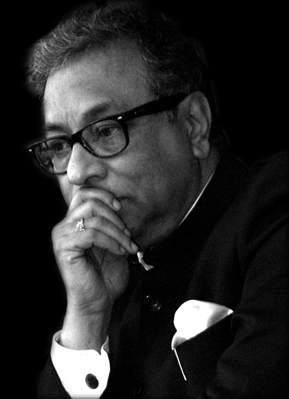
As I pen my sincere tribute to one the departed giants of modern Indian history, Prof Sumit Sarkar, I am overwhelmed with several feelings, many personal. I have intertwined my understanding of Sumit Sarkar with various phases of my life and the contexts in with he blossomed before me.
As son of the legendary historian, Sushobhan Sarkar, Sumit Da was one generation (13 years to be precise) my senior in Presidency College — among the better known seniors.
I had decided rather firmly to stay away from history in graduation and, I have therefore, missed out most of the excitement of growing up in the subject. Later on, when I did appear for an MA in History, it was in Ancient Indian History and Culture. I was then under the profound inspiration of scholars like DD Kosambi, RS Sharma, and later, Romila Thapar and DN Jha.
I may actually have kept my distance from modern history had it not been for the writings or EP Thompson, Eric Hobsbawm, Bipan Chandra, Tapan Raichaudhuri and Sumit Sarkar whose books swept me off my feet. For some odd reasons, RC Majumdar and Jadunath Sarkar did not enthuse me as much.
Sumit da's first book that caught my eye was "The Swadeshi Movement in Bengal, 1903–1908" that I read only after joining the IAS in 1975. I was excited with my new training and the challenges that we were taught to face. I was bored to death in the evenings in the district town, as I hardly drank and was not married which meant I had no wife for company or to quarrel with. As Collectorate libraries are richly endowed, especially with dated books. I devoured as many as I could. Most of these were on history and Sarkar's "Swadeshi Movement" opened my vision to the socio political life of my nation. Thence began my long trudge to understand and study the history of India during the nineteenth and early twentieth centuries.
But soon enough, my official duties started overwhelming me but my self-education — the only education that matters — was so consuming that I kept reading till well past midnight. But office work could often be troublesome and I remember how it took me several days to complete Sumit da's fascinating book "Modern India, 1885–1947". I was then District Magistrate of undivided Bardhaman — tumultuous and much too large and complex to manage at 33. The book went with me in my car all the time — as I reassured myself that I had not yet been trapped in the bog of mental debilitation — that all surrounding me, from pompous magistrates to scheming politicians and from corrupt contractors to manipulative district leaders were sure to inject me with.
I recall how I read the book in Circuit Houses and how I kept comparing my ongoing task of maintaining law and order with the momentous history that I read — of a nation getting its act together, against a formidable foe. Looking at the high teak wood beams on the ceiling my two centuries old building, I often wondered how several acts of repression against nationalist Indians must have been planned from this same DM Bungalow of Barddhaman that I occupied.
But it was Sumit da's "Writing Social History" that has been my keepsake. This work on social history in late colonial India surely express the evolution in the thinking of Sumit Sarkar, from his Swadeshi history. He emerged surely as an original thinker, not just a classical Marxist. His skilful treatment of social and cultural factors in history beyond the beaten path and any dogma — however useful it was. It was just fascinating.
In fact it is of so high a standard that it stops me from publishing my own average work on social history. I had the occasion to be in touch with him personally and over mail to seek guidance on my work on the social history of Bengal
Sumit Sarkar, the Marxist, never minced words — neither at nationalist historical studies that were open to question nor at the Communist Party. His last famous tick-off of Subaltern historians is the stuff of legends. Few could tell the-then emperors of history what clothes to wear.
May his soul find peace.