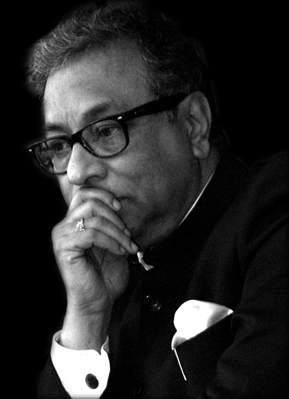
Himanta Biswa Sarma is ensuring that this poor Bengali-speaking Assamese citizen (who represents a significant chunk of Assam) be charged with treason, for the temerity of singing this Tagore song. Sarma would require a somewhat higher level or education or a wider worldview, both of which are not evident in him at present, to understand that the vast treasury of Bengali composition (and culture) is the common property of all Bengalis worldwide, whether they be in West Bengal, Bangladesh, Assam, Tripura, Britain, the United States or Nigeria
Himanta Biswa Sarma is upto his reprehensible antics once again. This time, he has picked on a very popular Rabindranath Tagore song Amar Shonar Bangla (‘O! My golden Bengal’) to declare its singing as an act of treason.
His ‘culprit’ is a small-town Congress leader in Sribhumi district of Assam, a Bengali, who innocently exhibited his Bengali genetic emotions. The Assam chief minister’s logic was that as Bangladesh had picked it up as its national anthem after its liberation in 1971 – something which conferred neither proprietary right nor copyright to that country – its singing is treasonous. Since PM Modi has used the opening line of the very song/anthem to woo voters in West Bengal, the video evidence of which is available, would he like to broach the treason provision here, too?
Any educated South Asian would be aware that the new Bangla republic had a staggering vault of Bengali songs to choose as its anthem. It had those of Tagore, Kazi Nazrul Islam, D.L. Roy, Atul Prasad, Farrukh Ali Qureshi, Rajani Kanta, Jasimuddin or even Farukh Ahmed who was known for his anti-colonial and political poems in favour of Bengali Muslims. Instead, Bangladesh chose the poet laureate, a Hindu of West Bengal, who was a scion of the landholding gentry that was much despised by the Muslim peasantry. There is no doubt that Tagore towered over others; that he was deeply in love with the eastern part of Bengal (today’s Bangladesh) and considered to be absolutely inseparable and passionate of the bond that unites the Bengali-speaking people all over.
But facts be damned: Himanta Biswa Sarma is ensuring that this poor Bengali-speaking Assamese citizen (who represents a significant chunk of Assam) be charged with treason, for the temerity of singing this Tagore song. Sarma would require a somewhat higher level or education or a wider worldview, both of which are not evident in him at present, to understand that the vast treasury of Bengali composition (and culture) is the common property of all Bengalis worldwide, whether they be in West Bengal, Bangladesh, Assam, Tripura, Britain, the United States or Nigeria. The fact that India chose one of Tagore’s songs as its national anthem and Bangladesh chose another (which is unique, as no single poet’s work has been shared thus) did not or does not ever preclude these beautiful compositions from being sung as a stand-alone songs or recited for the sheer profundity of their lyrics and sentiments.
“My glittering golden Bengal I love you.
The ambience of your air and sky seems like playing a flute in my heart.
The aroma of the mango orchard in the spring time drives me crazy,
O mother dear.
Autumn time sees smiles all through mature fields of paddy…”
It is an ode to ‘Bengal’, composed in 1905 when the province of Bengal was up in revolt against Viceroy Curzon’s order that dismembered its eastern half and added it to the Chief Commissioner’s province of Assam (set up in 1874) and made Dhaka the new capital. Incidentally, the very large and populous Bengali-speaking district of Sylhet of the East was forcibly attached to Assam, way back in 1874, despite protests. Then, in 1905, Lord Curzon ensured that a large section of eastern Bengalis were hopelessly mixed with the Assamese, to teach rebellious Bengal a lesson. To execute it, the British encouraged waves of Bengali peasants to settle in the fertile riverine regions of Assam. This explains why Assamese have been agitating, often violently, to get a large section (especially Muslim) of Bengalis out – though lakhs of them know no home other than Assam, for one and a half centuries. There are, of course, many Bangladeshis, both Muslims and Hindus, who infiltrated into Assam in recent decades. It is often (not always) difficult to segregate. Without this detour, we would hardly appreciate why many Assamese are so alarmed at the fragile demographic balance – that Sarma now plays upon, relentlessly. Nor would we realise that the vast majority of several generation-old Bengali settlers are an integral part of Assam and swear by it, come what may. Even the seven-hour planned slaughter of some 3,000 Bengali Muslims at Nellie in central Assam in 1983 has not had the desired result.
Tagore’s song, that is now considered almost seditious, was, in fact to protest against the British playing their dangerous chess games with human migration and misery in eastern India. By picking on this song as a treacherous recitation of an annoying neighbour’s national anthem, CM Sarma takes three potshots – first at Bengalis as such, which is kosher considering his rabble, then at the neighbouring country he has always considered hostile, even before Yunus, and finally, he also recharges his loyalty battery with the party he has defected to.
Though Narendra Modi, Amit Shah and their equally uninformed acolytes in the BJP of West Bengal often bend backwards to praise Tagore, especially before elections in the state, no one takes them seriously. Dina Nath Batra, the battering ram of Hindu fundamentalism, was more honest when his RSS-affiliated ‘Shiksha Sanskriti Utthan Nyas’ demanded in 2017 that the National Council of Educational Research and Training (NCERT) remove Tagore’s thoughts on nationalism from its textbooks. A few years ago it was reported that the Adityanath government has actually removed a famous short story of Tagore from the Class 12 textbooks in UP and included Adityanath’s own writings and Baba Ramdev’s in its place. One recalls how the Hindu Right keeps insisting that our national anthem is anachronistic (according to Kalyan Singh, governor of Rajasthan in 2015) or spreads the canard that Tagore had written it to praise King George V who was visiting India in 1912.
Can anyone in his right senses match these iconic words of Tagore with the constricted ideology of hate of Modi or Savarkar or their unapologetic intolerance as rolled out through the UAPA, CAA, NRC, and various anti-Muslim campaigns?
“Where the mind is without fear and the head is held high;
Where knowledge is free;
Where the world has not been broken up into fragments by narrow domestic walls…
Into that heaven of freedom, my Father, let my country awake.”
The fact is that when the Hindutva rabble-rousers run out of incendiary missiles to ignite further hate and divisions in society, they resort to dangerous distortion and lies. It applies universally to this tribe, across decades and continents, and is based on a sound psychological premise called the ‘big lie’, that Goebbels theorised for Nazis in Germany. Goebbels’s open espousal of ‘big lies’ to convince gullible masses can be traced back to his article ‘Aus Churchills Lügenfabrik’ (‘From Churchill’s Lie Factory’) that was published in Die Zeit ohne Beispiel on January 12, 1941. This was, incidentally, 16 years after Hitler’s first public use of the phrase.
After all, provocateurs like Sarma, Adityanath (or even Suvendu Adhikari, the hyper-aggressive BJP leader in West Bengal) have all to prove and renew their loyalty to the RSS-BJP high command on a daily basis – as they are not from the pure crimson-blooded stock. ‘Yogi’ is from an more bigoted political lineage and the other two (like many others) defected brazenly to the highest bidder, the BJP, from their respective Congress parties, for power and other obvious reasons. Sarma’s extra-belligerence is to allay the fears of his new masters about turncoats and this explains why he needs to sustain his systematic oppression of Muslims and Bengalis, or preferably both.