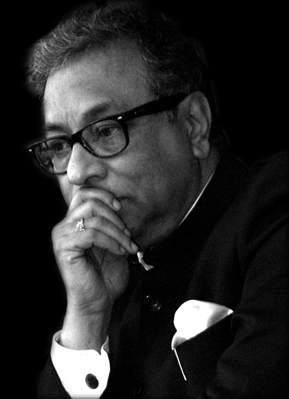
A unanimous decision was reached, that Birendra Krishna Bhadra and his ensemble would curate a fusion of hymns in Sanskrit from the Devi Mahatmya, which would be interspersed with Bhadra's narration in Bengali, and a chorus would come in at appropriate intervals. The background music would be rendered by an orchestra playing several Indian instruments.
The birth centenary of Bengal's greatest superstar, Uttam Kumar, is obviously the best year to shower him with well deserved tribute. And Bengal is certainly not miserly here, or at its quarrelsome best.
But amidst this blaze of glory lies a small tale which Uttam was keen to forget, and his millions of fans just wish never happened. This is about a disastrous appearance that the legend made in a radio programme on the 23rd of September 1976. He was at the height of his stardom, but his voiceover in a new 'religious' radio programme received a unanimous thumbs down, as this slot twas reserved for another incomparable programme.
The dawn was that of holy Mahalaya, Pujas (beginning roughly a week from Mahalaya), which Bengal celebrates with a gusto that is hard to imagine for an otherwise laid-back state. The dawn also belonged to Birendra Krishna Bhadra's sacred chants, his Mahishasura-Mardini, and no one could ever be imagined to replace him.
Mahalaya was, after all, at the cusp that marked the end of Pitri Paksh, the holy fortnight for reverence to ancestors, and the beginning of Devi Paksh, the fortnight reserved for the great goddess. More importantly, on this dawn millions of pious Bengali Hindus head for the ghats of the Ganga, or whichever river is available nearby. They perform Tarpan, the sacred Hindu ritual of offering water to their deceased ancestors (pitrs). and to other divinities and sages.
As mentioned, this dawn is also firmly embedded in Bengal's mind and soul with the sonorous recitation of the sacred hymns of Mahishasura-Mardini. It relates goddesses Durga's several battles over evil forces and this programme has been relayed over All India Radio, Kolkata, for generations on end. The verses chanted by Birendra Krishna Bhadra was in so inimitable a manner that it is said to stir the souls of even hardened atheists.
This is why the star-studded radio programme on Mahalaya day of 1976 provoked such an unimaginable cultural backlash in Bengal and elsewhere. Calls started flooding into Akashvani's Kolkata and other stations as early as 4 am, and protests continued even on the river ghats, as people prayed in waist-deep water. The anger at the sheer temerity of Akashvani continued unabated for a long time, even after Akashvani reverted to Bhadra's Mahishasura-Mardini the next year.
But Bengal's public displayed a visible self-contradiction, when it showed its anger, in no uncertain terms, at a radio programme led by Uttam Kumar, but it also refused to blame the iconic star at all. This almost-schizophrenic outrage may appear quite inscrutable — as many things are, about a highly emotional people. But the event is just too copybook a case for social psychologists not to cite it.
A flashback will take us first to a sweltering afternoon, the 26th August of 1927, when Bengal's Governor, Sir Stanley Jackson, opened Kolkata's first radio station, to encourage a private venture. But the valiant effort failed and on All Fool's Day of 1930, the government took over the radio station as well as the Delhi one. It launched the Indian State Broadcasting Service, which it later renamed 'All India Radio', on 8 June 1936.
In the initial years, Bengalis did not find the expensive imported radio sets cost-effective, as there were hardly any attractive programmes for them. So, the programme director of the radio station organised some brain-storming sessions with several top cultural personalities of Kolkata. They explored ideas to attract local audiences to the new medium and, obviously, to increase the revenues of the radio station.
It was in one of these meetings that a unanimous decision was reached, that Birendra Krishna Bhadra and his ensemble would curate a fusion of hymns in Sanskrit from the Devi Mahatmya, which would be interspersed with Bhadra's narration in Bengali, and a chorus would come in at appropriate intervals. The background music would be rendered by an orchestra playing several Indian instruments. This called for some special skills as most musicians were 'up-country' Urdu-speaking Muslims, who had no idea of what the holy hymns to Durga meant.
There are many disputes on the exact date of the first broadcast of this assembled programme. It is, therefore, safer to go by the blog of Akashvani that quotes from archival copies of the radio station's own journal, Betar Jagat Patrika. It says that the first programme with Bhadra, the iconic Pankaj Mallick and so many greats, titled Basanteswari, was broadcast on the 21st of October in 1936. This was on Maha Shashthi day and it was instantly the grandest hit of Kolkata's radio station
But since Maha Shashthi marks the first day of the 'Durga Puja holidays' many travel-loving Bengalis missed the unique experience as they were on trains heading out of Kolkata for vacation. The next programme was, therefore, brought forward by 6 days to coincide with holy day of Mahalaya. It was renamed Mahishasura-Mardini and was broadcast live every year. This meant that well over a hundred singers, musicians and recordists had to rush in the middle of the night to reach the radio station.
From 1962, however, live broadcasts were stopped and the recorded version was aired on Mahalaya at 4 am, year after year. People were not only never tired of listening to the same performance every year, but, instead, felt increasingly thrilled to be a part of the glorious everlasting cultural tradition of Bengal.
A careful examination of the last claim will reveal that while the tradition may well last for ever, its origin was much too recent, in 1936, to position it to some hazy romantic past. This is exactly what Eric Hobsbawm has described as the 'invention of tradition'.
The second issue that belies its unbroken history is that Uttam Kumar's programme broke the continuity in 1976. This Is where we started. But Uttam Kumar did not actually replace Birendra Krishna Bhadra. Instead, the radio station created a completely new programme in 1976, called Debīṃ Durgatihāriṇīm. It was conceived by a top Sanskrit scholar and had its new lyrics. Its music direction was by Hemant Kumar — Bengal's own Hemanta Kumar Mukherjee.
But this attempt by Akashvani to replace an old cultural format with a new one, that had Lata Mangeshkar, Asha Bhosle, Manna Dey and Bengal's topmost singers, proved to be an unmitigated disaster. Incidentally, Uttam Kumar was initially quite reluctant to do the narration and was reportedly persuaded by Hemanta Mukherjee and others. An AIR-related account says that he was paid only 150 rupees for the recording.
Bengalis were outraged at All India Radio for insulting their 'everlasting tradition'. It was as if they were collectively expressing, unconsciously or otherwise, their protest against the prevailing Emergency itself, for the sheer arrogance of tinkering around with a sacred institution. The radio station had totally misjudged when it planned to rub off some of Uttam Kumar's incomparable popularity on to the programme.
There was unusual and rare unison among one of India's most argumentative people that Mahalaya was reserved for Bhadra's Mahishasura-Mardini and for nothing else. As Uttam Kumar put it in his wise hindsight: "We cannot renovate our family's worshipping space into a swank drawing room".